

Case study
Drinks Tendering Platform
A UX/UI concept for a two-sided marketplace connecting bars with drinks producers.
Problem
Bars and drinks producers had no structured way to find each other and agree supply deals.
Approach
Learn first, design second: A research plan covering both user groups, then high-fidelity screens for the two most important moments, browsing today's tenders and filtering them.
Outcome
A research-led proposal and a set of test-ready screens that show how a tender marketplace could work for both sides.
The brief
The goal was to design a tendering process that brings bars and drinks producers together. There are two distinct user groups:
- Bar owners create a tender for a drink they need to be supplied.
- Drinks producers submit bids to those tenders, with their own products and pricing conditions.
The challenge
A marketplace has two sides, and a mistake on either one breaks the other. Before designing anything I needed answers to questions the brief didn't cover: Does something like this already exist, is there real demand, and what does the client assume to be true?
My approach
I proposed five steps, each building on the last:
- Empathize: Learn how the market and its users work today.
- Research: Interview both groups about goals, desires and pain points with the methods they use now.
- Ideate: Generate user flows and wireframes from a wide pool of ideas.
- Prototype: Design solutions to a mid-to-high fidelity stage.
- Test and learn: Test at least two options against each other (A/B or multivariate) rather than committing to the first idea.
Starting with the right questions
I prepared the questions I would ask at the kickoff meeting:
- Is there an existing or similar product? I'd ask for a list of direct and indirect competitors.
- How do we know there is a need right now?
- What assumptions does the client already hold, and what are their goals?
- What should the research goals be, and what do we want to learn?
- How will success be measured?
I split the research questions into must-knows and nice-to-knows, so that time in interviews went to the questions that could change the design.
A risk I flagged early: Research can produce unexpected results, and the real problem may differ from the original idea. I recommended preparing the client for the possibility that the scope would change if the evidence pointed elsewhere.
Research plan
I wrote separate interview guides for bar owners and drinks producers. Each guide asked participants to:
- Describe, step by step, how they buy or supply drinks today
- Demo the process on screen if possible, so we see what they do rather than what they remember
- Name the tools they use and how long the process takes
- Say what frustrates them most and what delights them
To make sense of the results I planned a competitor analysis and an affinity map, plus a 2x2 matrix comparing business goals and user goals to show which processes work and which don't.
Open questions I raised
- How are winning bidders notified, and how do unsuccessful distilleries find out?
- Which platform should come first: Mobile, tablet or desktop? Usage data should decide this.
- The concept will probably need two to four further use cases, mainly how producers place a bid and create an account, and how bar owners create a tender and set up theirs.
- Once the concept is clear, a design system would help test buttons, colours and calls to action consistently.
The interface
I designed the first screens around the tasks users return to most often.
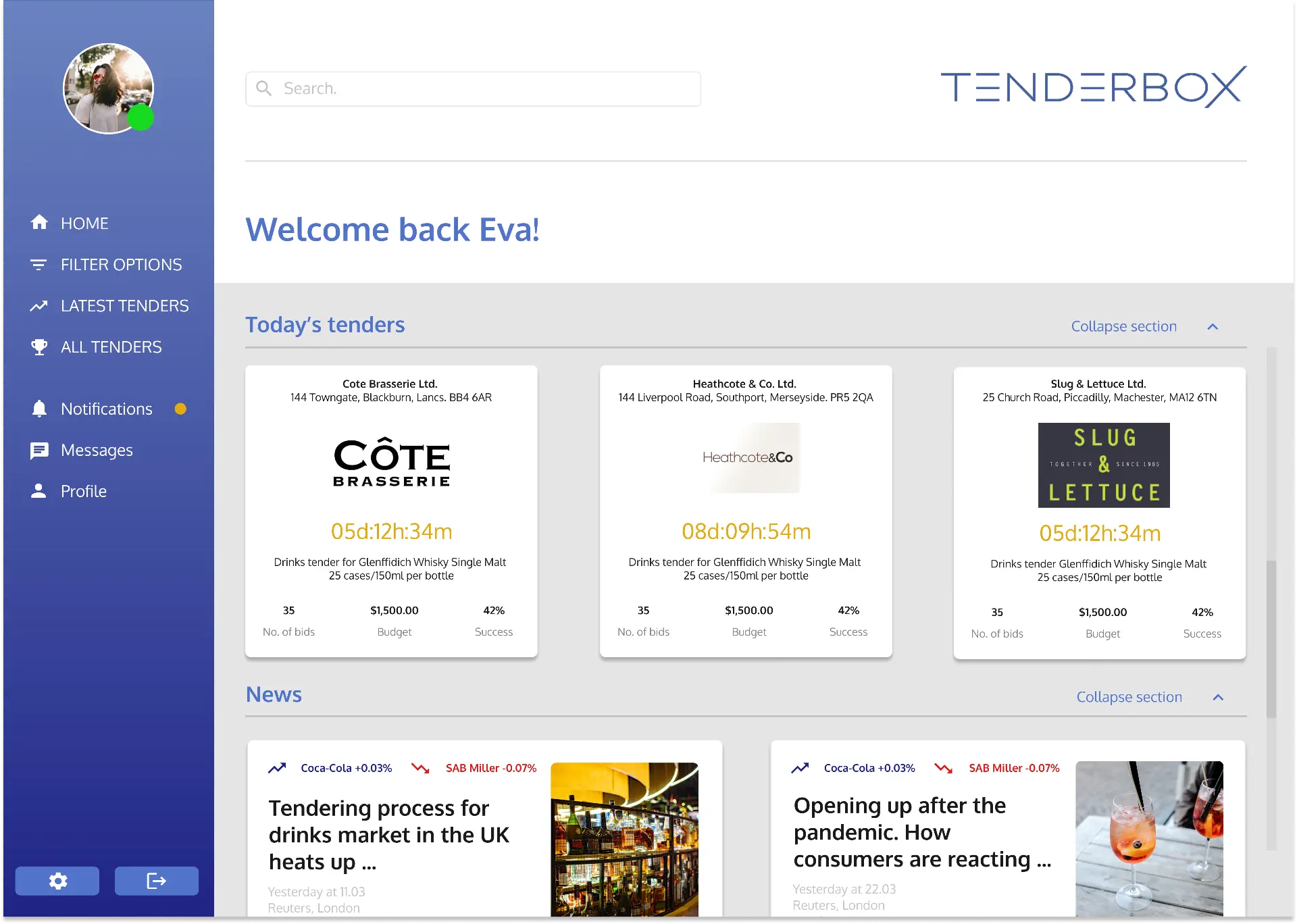
Home: today's tenders at a glance. Each tender card shows the bar, a countdown to the deadline, the number of bids, the budget and the success rate, so a producer can judge whether a tender is worth pursuing without opening it. A news feed beneath it keeps market context in the same place.
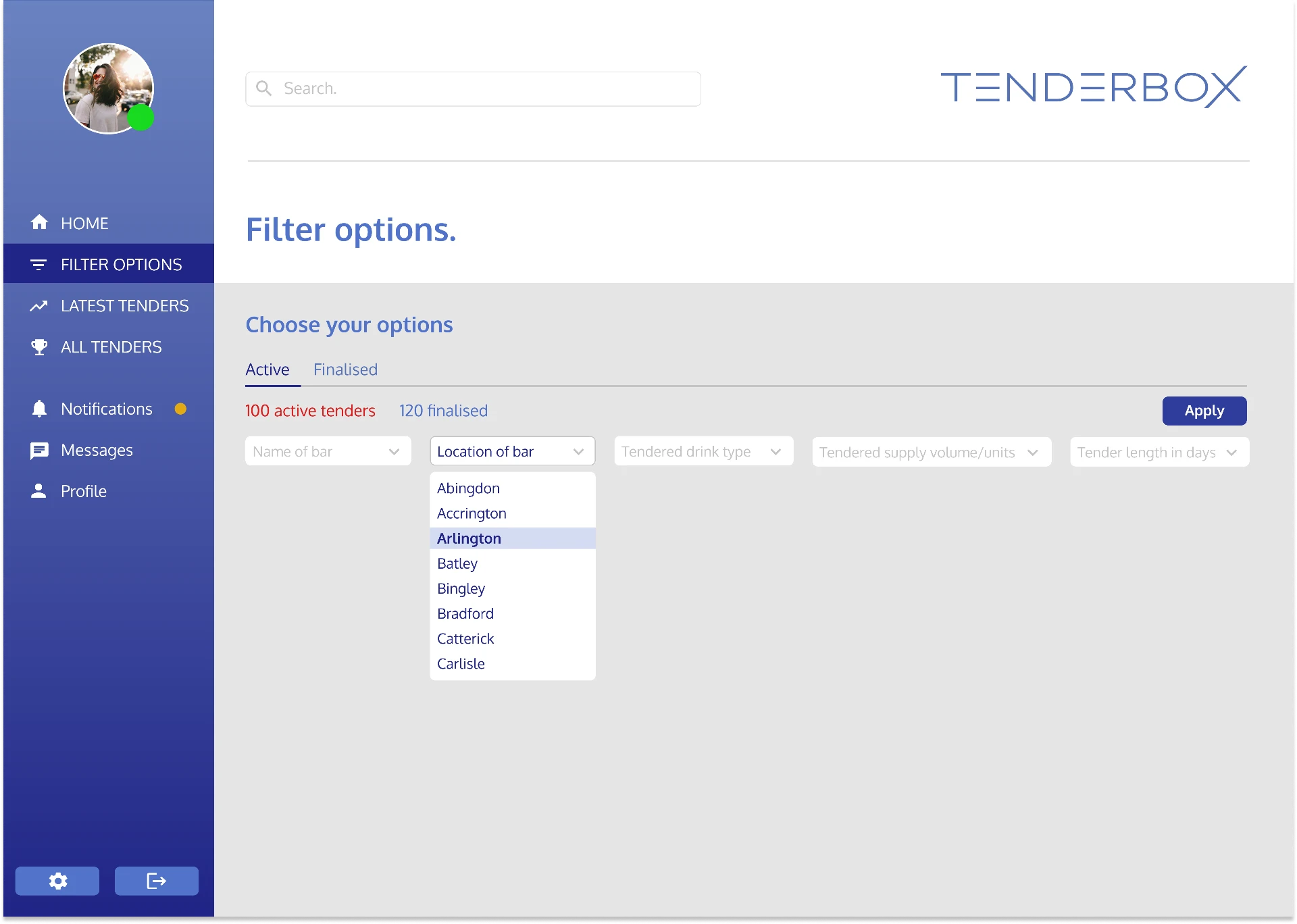
Filter options. Tenders are split into Active and Finalised, with counts shown beside each tab (100 active, 120 finalised). Producers can filter by name of bar, location, drink type, supply volume and tender length, then apply the filters in one step. I designed several screen states for the filters, including the open dropdown, to test which pattern works best.
Personas
I recommended a persona for each target group, with goals, desires, pain points and basic demographics, so the whole team would know who they were designing for. I started with Julia, a fictional bar owner struggling to source suppliers.
What I'd do next
- Run the interviews and update the personas with real findings.
- Test at least two versions of the filter pattern.
- Design the bid and tender-creation flows, which carry the most risk.
- Define success metrics before launch so that results can be measured.